
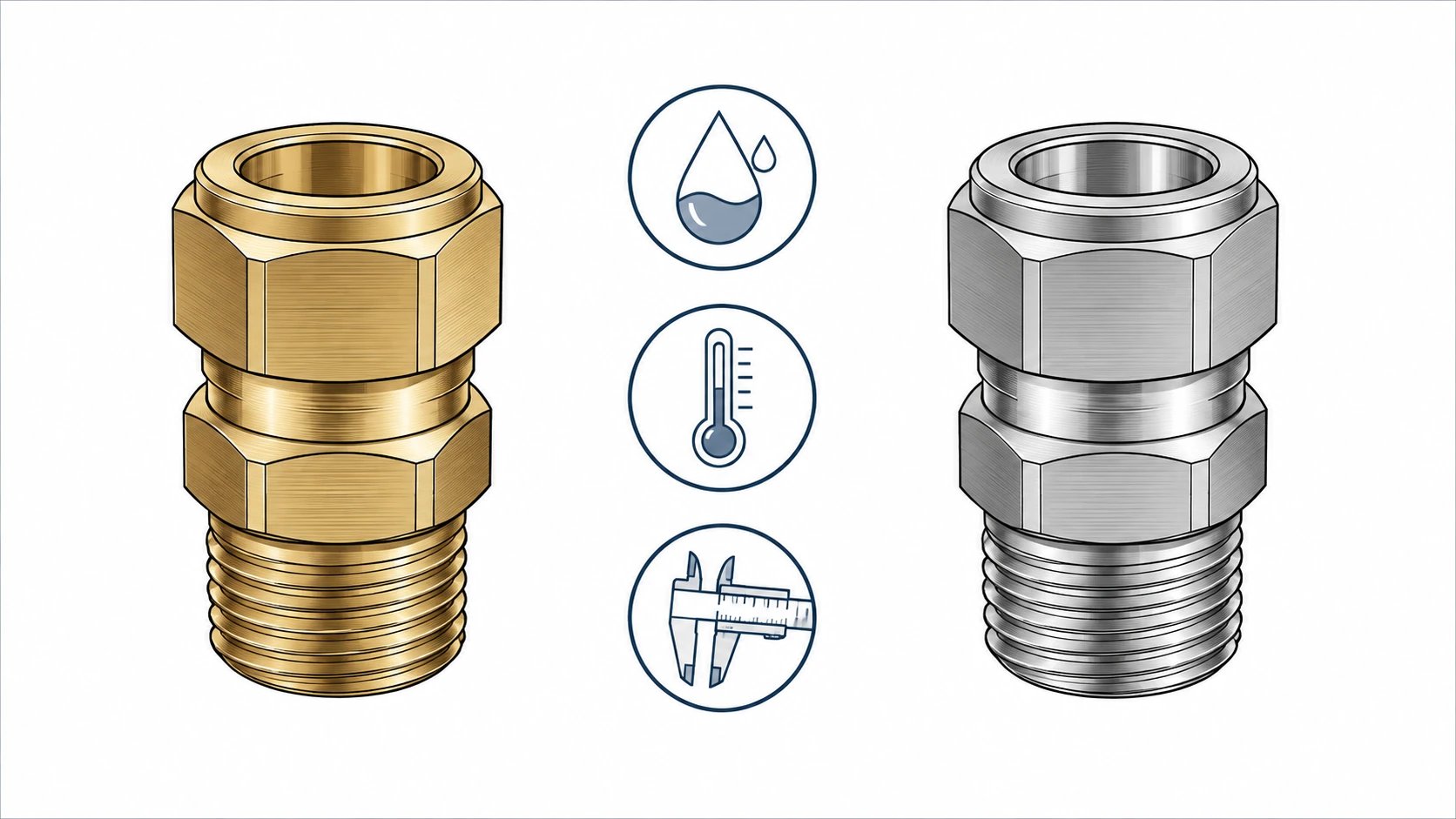
Brass or 316 Stainless Steel for Custom Fittings: Compare the Service
Compare exact alloy, fluid compatibility, strength, machining and joining requirements before selecting a fitting material.
 Zaid ArshadManufacturing Content Author · KEC Tour

Name the exact material
Brass and stainless steel are families, not complete purchasing specifications. Identify the alloy, product form and required material documentation. Where chemistry, lead content or certification matters to the application, state it explicitly. A quotation for a generic brass fitting cannot be assumed equivalent to a specified lead-free alloy, and a stainless appearance cannot establish that a component is 316.
Check the fluid and environment
Review compatibility with the actual fluid composition, concentration, temperature and external exposure. Consider cleaning agents and stagnant conditions as well as normal operation. Neither brass nor 316 is universally corrosion-proof. Obtain application-specific guidance from the responsible engineer and relevant material or component supplier, especially where chlorides, ammonia-bearing environments or demanding cleanliness conditions may affect the choice.
Design the pressure boundary independently
Material choice alone does not establish a pressure rating. Wall thickness, geometry, thread engagement, manufacturing quality and the applicable design requirements all contribute. Review the finished component and its mating connection as a system. Avoid copying the rating of a catalog fitting onto a custom part that merely uses the same alloy or nominal thread size.
Compare the complete machining route
A more readily machined alloy may reduce cycle time, but the comparison must use the same final requirements. Include material cost, tooling, deburring, cleaning and inspection. Stainless threads may require attention to assembly conditions and galling risk, while a brass part may have different strength or environmental constraints. Ask for separate cost drivers when those differences change the recommended manufacturing route.
Verify the supplied and assembled condition
State the required finish, passivation where applicable, cleanliness and traceability. Review dissimilar-metal contact in the installed assembly rather than checking each part in isolation. If a substitute alloy is proposed, assess functional and compliance requirements before authorizing it. Retain the approved material identity with the drawing so a future purchasing substitution cannot silently change the service suitability.
Approval checklist and evidence
| Review item | Decision to make | Evidence to retain |
|---|---|---|
| Service | Confirm the actual fluid and external environment. | Compatibility review covering temperature and cleaning agents. |
| Alloy | Specify exact material rather than a broad family. | Traceable alloy designation and required documentation. |
| Design | Establish pressure-boundary requirements for the custom part. | Approved geometry and product-specific verification plan. |
| Supply route | Compare final-condition costs and substitution controls. | Equivalent quotations and documented approved material choices. |
Worked review example
Illustrative scenario: a buyer compares a brass adapter quotation with a 316 stainless version. The brass price is lower, but the request omitted the fluid and cleaning chemistry. The comparison is paused until the service conditions and exact alloys are confirmed. Only then can machining cost be weighed against compatibility and product requirements. This example is a selection workflow, not a recommendation that either material is suitable for a particular pressure system.
Information for the engineering review
- Exact alloy and material documentation
- Fluid, cleaning and external exposure
- Approved pressure-boundary design
- Complete machining and finishing route
- Assembly compatibility and substitutions
Discuss this requirement with KEC Tour using the controlled drawing, the relevant mating interfaces and the review information above. Identify the decision that needs confirmation and the acceptance evidence expected with the first parts.
Sources and further reading
Frequently asked questions
Is 316 always the safer choice?
No. Suitability depends on the actual environment, design and applicable requirements.
Can color verify a brass or stainless alloy?
No. Use traceable material documentation and appropriate verification when required.

Zaid Arshad
Manufacturing Content Author · KEC TourZaid Arshad writes practical manufacturing guides for engineers and sourcing teams evaluating custom fittings, CNC-turned parts, sheet-metal components, stampings and die-cast parts. His articles focus on clearer RFQs, supplier evidence, inspection planning and drawing-to-production decisions.
View author profileRelated engineering guides

Engineering Changes for Custom Metal Assemblies: Control the Cutover
Link revised drawings, purchased parts, work in progress and inspection so a design change reaches the correct production units.
Read article
Burr Direction on Stamped Parts: Put the Functional Edge on the Drawing
Specify the acceptable edge condition and orientation where stamped parts contact seals, wires, hands or mating surfaces.
Read article
How to choose stainless steel grades for non-standard fittings
A practical guide for balancing corrosion resistance, machining stability, pressure use, surface finish, and cost.
Read articleTurn your requirements into a production-ready RFQ.
Share your CAD file, material, critical dimensions, finish and target volume. KEC Tour will review the process route before quoting.